Cable Management Safety: Importance of Proper Support Brackets
Cable tray support brackets are often overlooked in robotic cell design, even though they impact uptime. Get selection tips, professional insight, and more.
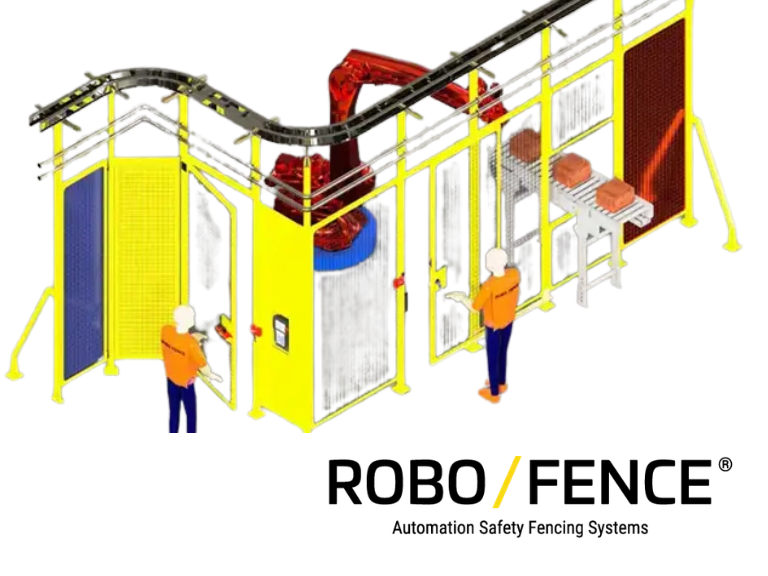
Gate configuration influences much more than access to the cell itself. The configuration influences how much floor area the cell requires, the production workflow, and the maintenance of the cell itself. Gates must provide good access into the cell without being awkward or inconvenient to use, meet strength and security demands, comply with OSHA requirements, and integrate readily with existing equipment.
When you’re designing guarding for your robotic cell, consider:
There are several considerations for determining gate access type:
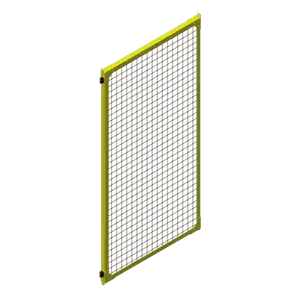
Hinged gates are mounted to sturdy vertical posts and rotate through an arc to pivot open. A single gate may provide sufficient clearance for worker access, but double gates are often needed for forklifts.
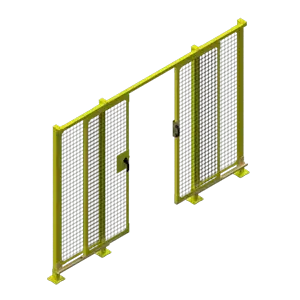
A sliding gate moves parallel to the adjacent fence panels. Sliding gates can be a single panel, a pair of panels that slide in opposite directions, or even consist of multiple stacked panels. Sliding gates can also be configured for vertical movement, allowing a crane to move large items into a cell without disrupting operations.
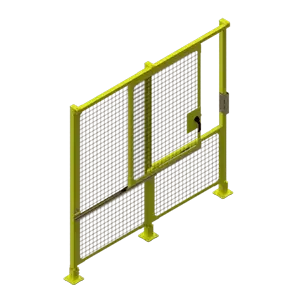
This configuration uses an overhead track or rail to support the gate as it moves, helping avoid the need for a floor-mounted rail that could hinder operators and lead to contamination. However, the track must be strong enough to support the gate’s weight, and it imposes a height limit on cell access.
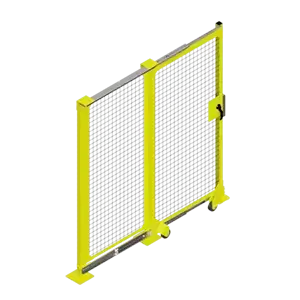
A total access gate allows entry to the entire enclosed and protected area, rather than just one section.
Total access gates require closer attention to safety interlocks to meet the relevant safety requirements. These types of gates may also require an emergency escape path or a way of checking the cell is unoccupied before being closed.
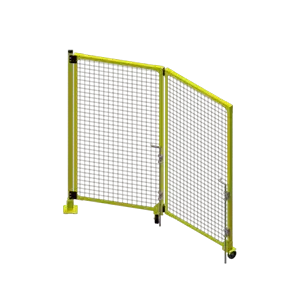
A bi-fold gate is hinged vertically halfway across its width. To operate, the opening edge slides back in the same direction as the adjacent panels, and the gate folds in half. Bi-fold gates are usually mounted on wheels but may also be mounted on tracks to ensure proper movement.
A bi-fold gate that folds into the cell has the advantage of not impeding traffic past the outside of the cell.
Latches for robotic cells need to hold the gate in its correct position for safety interlocks to work. It should not be possible to operate the gate without the safety system recognizing that it’s being opened or closed.
For both latching mechanisms, the primary consideration is whether access is needed from one or both sides.
These latches are bolts that drop into a hole in the floor, preventing the gate from being opened.
In this latching design, the bolt slides sideways into a recess or pocket, ensuring the bolt can’t be knocked free or loosen from vibrations.
Tracking supports the weight and movement of sliding gates and ensures proper alignment as the gates close. Tracking must have the strength and durability to withstand frequent, heavy use without deforming.
Because it spans the opening, tracking can sometimes prevent tall vehicles or stacked pallets from entering the cell.
A relatively lightweight design intended for narrower single panels where the gate will close against a rigid post.
A stronger form of tracking intended to support large, heavy sliding gates and multi-gate installations.
ROBO FENCE® by Square Group provides peace of mind to manufacturers by engineering advanced guarding systems tailored to specific applications and facilities. We provide 2D and 3D in-house design capabilities and responsive support. Visit our website to learn more about our available configurations, or contact us today to get started with a design consultation.

Contact one of our experts to get started on your next machine guarding project. Until then, browse our complete catalog to see our offerings.

Square Group LLC
Proud Manufacturers and Suppliers of ROBO FENCE®