Cable Management Safety: Importance of Proper Support Brackets
Cable tray support brackets are often overlooked in robotic cell design, even though they impact uptime. Get selection tips, professional insight, and more.
Panel selection is one of the many critical aspects of robotic cell fencing design. Selecting the wrong type of panel can create operational problems, ranging from equipment jams to extended downtime, as well as unanticipated accidents and injuries.
As with any robotic integration process, the first step is to perform a risk assessment. This safety assessment will help you understand the unique risks in your facility and identify mitigation solutions.
Once you perform this risk assessment, consider the following when selecting panels for your guarding:
Product safety capabilities are described in two ways: Performance Level (PL) and Safety Integrity Level.
PL is a scale, defined in ISO 13849, from ‘A’ (the lowest) to ‘E’ (the highest). The PL required for the application is determined by following a chart given in the standard. Most robotic systems earn a PLc or PLd assessment.
Safety Integrity Level is an alternative to Performance Level that focuses on assessing risk probabilities and is primarily used in process industries. PL promotes redundancies and diagnostics, and most industrial automation safety specialists find it easier and more intuitive to use.
Interlock switches, locking mechanisms, and other access door hardware are all risk points for dust, dirt, and moisture that can cause problems. Ingress Protection (IP) ratings provide a way to define the level of protection needed. Most industrial systems need at least IP65, with many using IP66 or IP67.
The first digit indicates the level of protection against solids; the second, against liquids. The advantage of higher ratings is better protection, especially against liquids, which may be used for cleaning or in automated processes.
Around electrical equipment, points like glands and cabinet doors are especially vulnerable. The various types of interlocks used with access doors are often at the highest risk of damage and so need the highest protection.
When selecting robotic safety fencing panels, an often-overlooked aspect is the impact of local environmental conditions, including shocks, vibration, chemical exposure, and even UV light, on the materials used for the fence panels.
Shock impacts, such as a forklift colliding with a panel, can cause deformations that affect gate opening and security. Vibration, often present in grinding or trimming operations, can loosen fasteners and fatigue-stressed elements like mounting points.
Chemical exposure is often caused by airborne cutting fluids or cleaning liquids and can blister paint, strip other coatings, and damage polycarbonate panels. UV exposure can also pose a hazard to polycarbonate panels. While formulated with some UV resistance, prolonged exposure can lead to yellowing and even embrittlement.
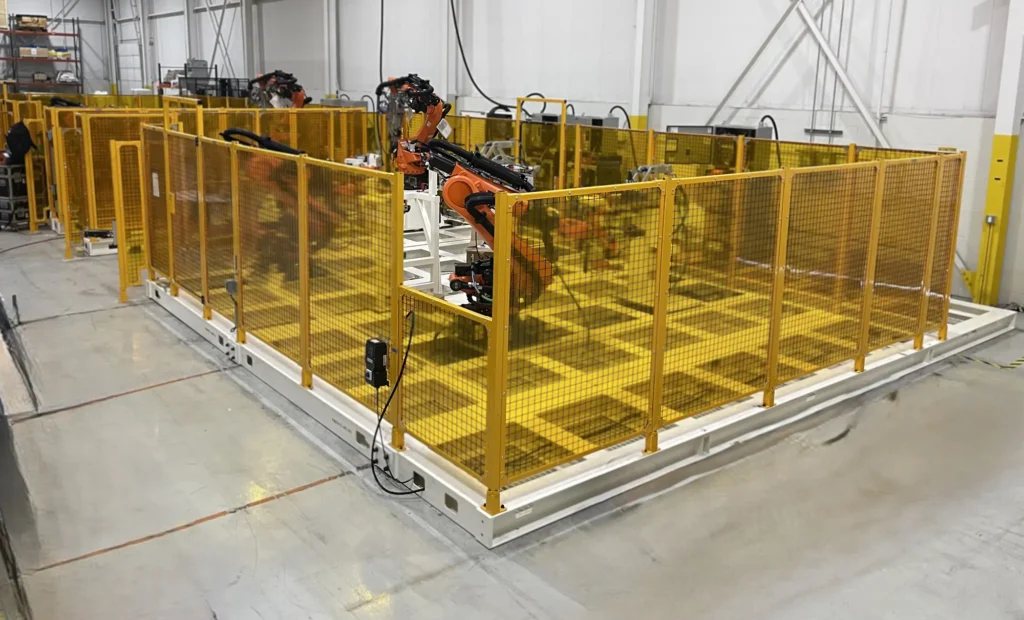
Consider:
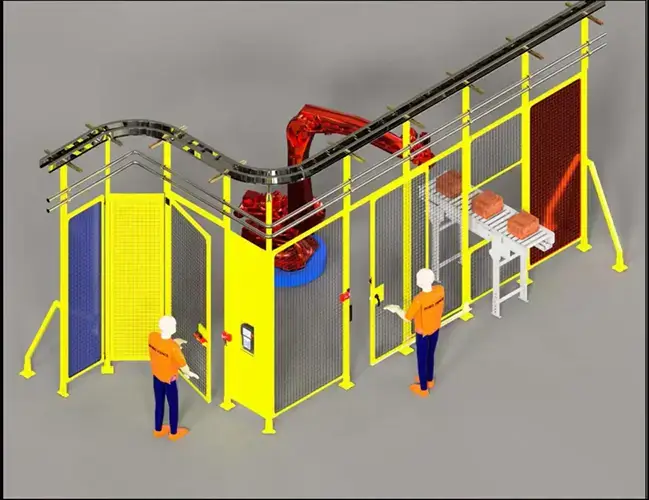
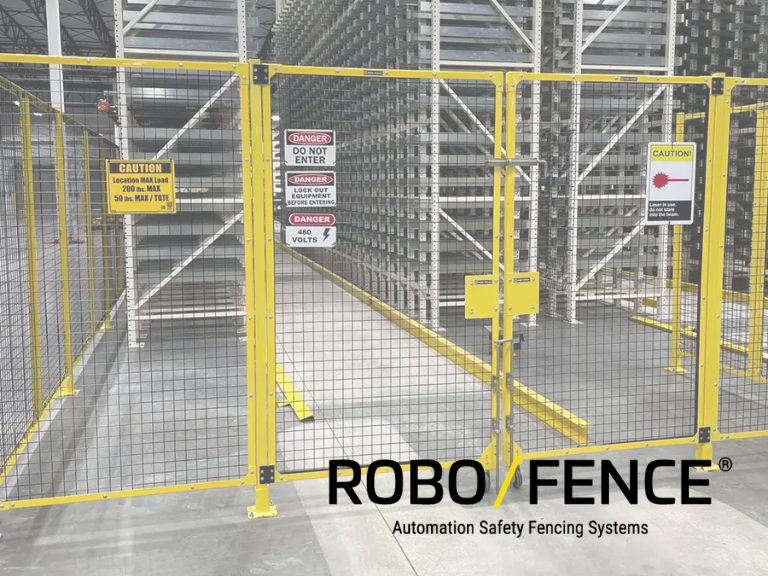
Gates control entry into the cell and usually have a key-operated mechanism that puts the robot into a safe state before they can be opened.
Light curtains linked directly to the safety controller respond faster and are sometimes preferred when frequent access is needed. However, they can be triggered accidentally, which disrupts routine operations.
Gates can also be hinged or sliding. One advantage of sliding gates is that they don’t need space for a swing arc. They can also open wider than hinged gates for forklift access when performing maintenance or replacing equipment.
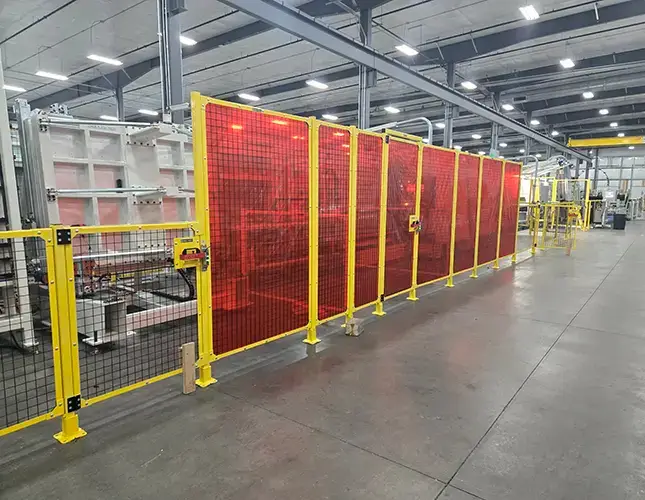
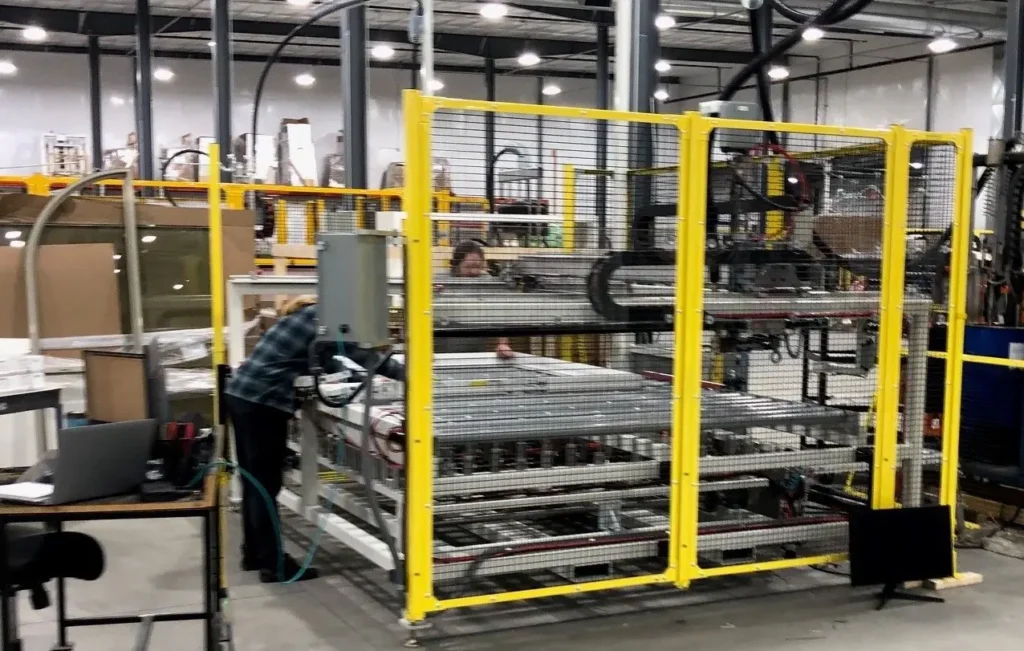
Good visibility into a cell allows verification of correct operation and quick identification of any problems. Mesh panels are the most effective method, with polycarbonate panels a close second.
However, some processes, such as robotic trimming and welding, are best protected by solid screens because they help block and contain hazardous debris. Additionally, some proprietary processes may require solid panels to limit visibility and improve security.
Most manufacturing plants are limited in the amount of space they can provide for a robot cell. The three primary issues are 1) robot working envelope, 2) access space for maintenance, and 3) room needed for gates and cell entry.In some cases, space constraints are addressed by mounting the robot on a pedestal or even upside down. However, this can affect the height and width of safety fencing needed. It may also mean the cell taking an irregular shape to fit into the available space. In such situations, custom safety fence panels might be required.
When designing robotic cell fencing, remember that different panel types can be mixed. A cell might have mesh along one side for good visibility, but be solid along an aisle to protect nearby workers from hazards.
The important point is that cell fencing must meet applicable safety standards, address and mitigate the risks found in your initial assessment, and be robust enough to handle local environmental conditions.
ROBO FENCE is a domestic manufacturer specializing in engineering custom machine and robotic guarding systems. We offer innovative designs, competitive pricing, and world-class support.
If you’ve already performed a risk assessment, contact us today to schedule a design consultation, or visit our website to explore our panel options.
Contact one of our experts to get started on your next machine guarding project. Until then, browse our complete catalog to see our offerings.
Square Group LLC
Proud Manufacturers and Suppliers of ROBO FENCE®