CAD Design in Machine Guarding: Why 3D Models Matter for Installation Efficiency
Learn how and why 3D CAD models streamline the robotic cell and machine guarding design, planning, and installation processes.
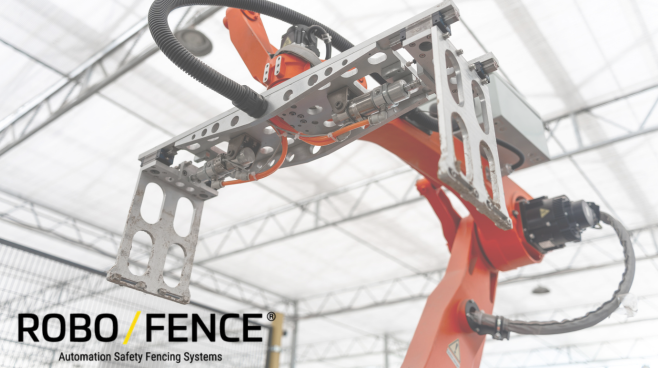
When you’re designing a new robotic cell, don’t forget about cable tray support brackets. These small but powerful components often get overlooked during initial design and installation, even though they can cause downtime, when the wrong configuration is used or installed in the wrong location.
Cable trays serving robot cells often carry heavy, high-voltage cables that drive the robot, plus power for end-of-arm tooling and other equipment within the cell. Low voltage and network cables, including those used for cameras, lighting, and sensors, are sometimes routed along the same path. In some cells, cable trays will also carry compressed air lines and pipes supplying the water and other fluids the processes or operations need.
Selecting the right brackets requires reviewing load requirements and environmental conditions (brackets are often exposed to vibration, cyclic motions, temperature changes, dust, dirt, liquids, and gases), as well as ease of installation/removability, particularly because cells are frequently revised and upgraded with new capabilities.
Start by calculating the expected weight of all the cables and any fluid lines in their filled condition. Determine a safety factor to add to allow for future upgrades to the existing cell. When deciding how large this should be, consider that upgrades could include new capabilities, such as welding, that require larger and heavier cables.
Water-cooled torch leads, dispensing hoses, and heavier servo cables for additional axes can add significant weight, so choose a bracket with a load rating that comfortably exceeds today’s requirement rather than one sized closely to it (to support future upgrades). If new cables need to be kept separate from existing ones, opt for brackets that accept a second arm or support multiple tiers that allow you to add capacity without replacing the bracket.
Next, identify the spacing between support brackets and use it to determine the worst-case (maximum) future load per bracket. If heavier upgrades are likely, it’s more cost-effective to install brackets closer together from the start than to retrofit additional ones later, since this reduces the load each bracket carries.
Lastly, consider how the tray support is mounted to the vertical post. A wide tray on an end-mounted support will apply significant leverage, while a top-mounted support can carry a heavier load. Check the bracket’s rating at its full arm length, not just near the post, since capacity drops as the load moves farther out. You may also consider a heavier-duty bracket with the same mounting footprint so you can increase capacity without re-drilling posts.
Industrial automation involves some motion, and that’s especially true for robotic cells. Conveyors are common for moving parts in and out, although gantries and turntables are used in some setups.
This motion creates vibration that can travel into the cable trays and loosen fasteners. Where possible, mount brackets on independent posts rather than directly on conveyor frames or other vibrating equipment. Where that isn’t possible, specify locking fasteners and consider elastomeric isolators between the bracket and its mounting surface.
Beyond loose fasteners, a bigger concern that movement/vibration poses is the potential impact of moving cables, pipes, or hoses, as often installed with gantries and robots. Although service loops should handle some of this, movement can still place cyclical side loads on the trays and support brackets. Look for brackets rated for dynamic or fatigue loading, not just static weight, and pay attention to designs that are stiff sideways as well as vertically. The bracket nearest the point where cables leave a cable carrier or robot dress pack is especially important because it anchors the run and prevents motion from traveling along it. Brackets with built-in tie-down points or strain-relief provisions are useful, as are rounded or protected edges that won’t cut into cable jackets. A heavier-gauge or reinforced bracket is also less likely to fatigue or resonate with nearby equipment.
The environment can affect cable trays and, in turn, the electrical and communication systems they support. For example, in many plants, horizontal surfaces act as magnets for dust, and this can be a particular problem when that dust is electrically conductive, as might be the case where graphite or cast iron are machined. Bracket designs with open or angled profiles collect less dust and coolant residue than those with flat ledges or enclosed channels, and they’re easier to inspect and wipe down.
Temperature changes can also cause problems, such as shifting support and cable tray positions, which can accelerate cable fatigue and lead to a variety of faults that are hard to diagnose. On longer runs, brackets with slotted tray-attachment holes or slip-fit clamps allow the tray to expand and contract without forcing the brackets out of alignment. Near welding stations, spatter can damage bracket coatings and create rough spots that damage cables, so position brackets away from the weld zone where possible.
Washdown environments also pose particular challenges for cable tray support brackets, especially when caustic materials are used because they can accelerate corrosion, reduce load-carrying ability, erode coatings, and allow sharp edges to form. Stainless steel brackets, especially 316 stainless steel, offer better resistance to chlorides and cleaning chemicals, while fiberglass-reinforced plastic brackets can perform reliably in aggressive environments, though their load ratings are lower than stainless steel.
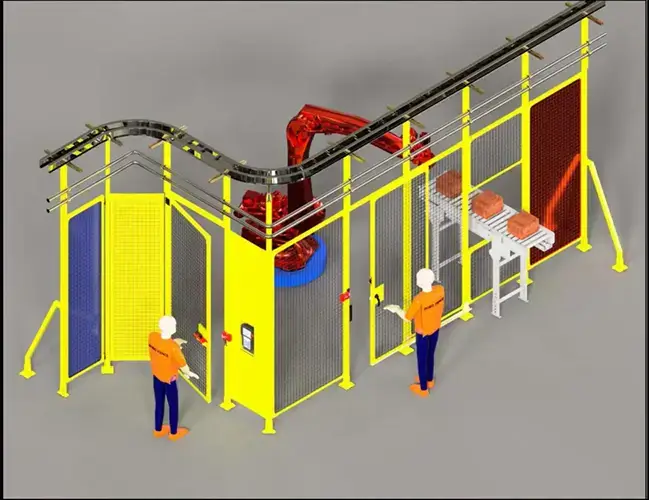
Cable support brackets are often mounted on vertical posts like those used to hold guard panels. In these situations, the brackets can be mounted on the side of the post in an ‘L’ configuration, or across the top as a ‘T.’
The T-configuration eliminates any risk of slippage but may not provide the same ease of access as the L. It may also mean the trays are not at the ideal height for the cell or that taller guard posts must be specified.
Support brackets must always be installed in ways that keep them and the cable trays outside the robot’s envelope. This means routing cables around the cell perimeter rather than over the top from one side to the other. While the material savings of this latter arrangement might be attractive, unless the trays are above the highest point the robot can reach, there is a risk of an expensive and potentially dangerous collision.
Base the clearance on the robot’s full mechanical reach. The envelope should include the end-of-arm tooling, the dress pack, and the largest part the robot might carry, along with a clearance margin. Ensure the brackets don’t obstruct maintenance access, cell doors, light curtains, or area scanners.
Industrial automation often changes multiple times during its operating life. Continuous improvement efforts can identify revisions that improve productivity and quality, and product updates can require new manufacturing processes. Adding welding or robotic sealant dispensing are just two common examples.
As a result, the cell layout will change, and so will the assembly of pipes, hoses, and cables that keep the system running. When designing and installing brackets with future upgrades in mind, ensure you’re selecting a flexible option that can be easily adjusted or replaced if needed. Look for slotted or clamp-on mounting that lets you adjust height and position without drilling, or designs that accept add-on arms and tiers.
Cable tray support brackets can significantly affect uptime and upgradability, so don’t forget to include them when planning your initial design.
ROBO FENCE offers robotic cell design assistance and custom machine guarding, manufactured by our U.S.-based partner, Square Group. Our experts can help you select the best panels, gates, posts, and cable tray support brackets for your application, and even help you retrofit your existing system.
Visit our website to learn more about our products, or contact us today to get started with a design consultation.
Contact one of our experts to get started on your next machine guarding project. Until then, browse our complete catalog to see our offerings.
Square Group LLC
Proud Manufacturers and Suppliers of ROBO FENCE®