Cable Management Safety: Importance of Proper Support Brackets
Cable tray support brackets are often overlooked in robotic cell design, even though they impact uptime. Get selection tips, professional insight, and more.
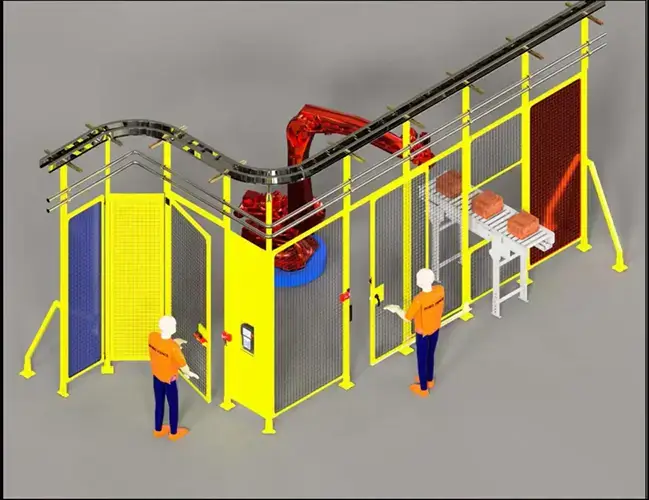
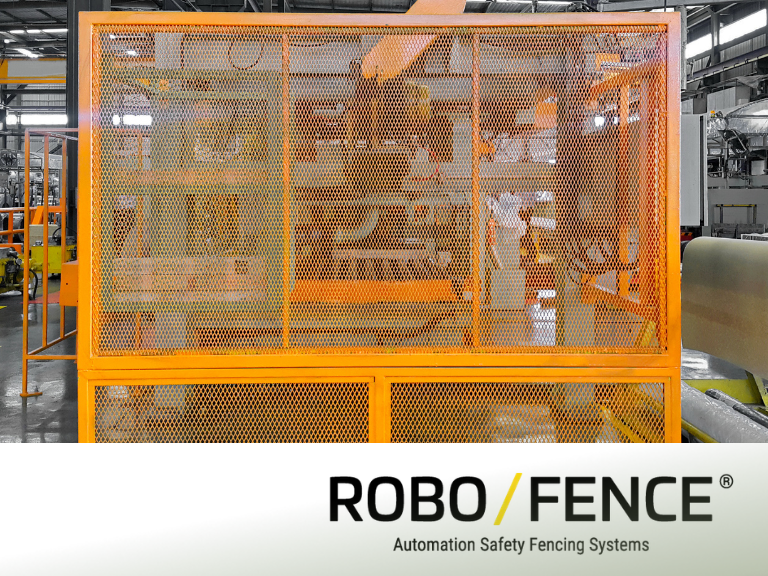
Guarding separates workers from potentially dangerous machinery while causing minimal inconvenience and using as little floor space as possible.
Traditionally, this design challenge was tackled with two-dimensional drafting. Whether done on a drawing board or with computer-aided design (CAD), it involved creating flat drawings that showed the fences or panels from just a few perspectives.

Today, though, many engineers prefer to use a 3D CAD model for robotic cell guarding, which adds a ‘z’ dimension to the ‘x’ and ‘y’ of 2D. It also adds parametric associativity, where a change in just one design feature, like a hole position, ripples through all aspects of the design and prevents the errors that are so easy to make with 2D design. 3D CAD also lets engineers rotate and view a design from any angle to check for conflicts.
When building guarding systems for robotic cells, 3D design simplifies and streamlines the installation process by:
One of the biggest challenges in designing robot guarding is making the cell as small as possible while maintaining the separation distances that keep operators safe. That separation is better than simple collision avoidance. The fence must sit clear of the robot’s restricted space and leave enough gap that a person can’t be crushed or trapped against the barrier by the arm at full extension.
Verifying clearance is extremely difficult to do in 2D CAD because the robot’s reach envelope is a complex volume rather than a simple sphere, and conflicts (where the design has two items occupying the same space) rarely stand out in a flat view.
With 3D CAD, the restricted space can be defined as a solid, imported alongside the cell and guarding models, and checked directly. The 3D CAD model immediately highlights any areas where there is a potential conflict. Guarding can then be modified in the design phase rather than after installation.
Cycle time is influenced by factors like path geometry, joint kinematics, tooling orientations, and the robot’s speed and acceleration limits under the actual payload. Robot manufacturers provide simulation products that model all of these things.
Importing 3D CAD models of the cell guarding into those simulators protects cycle time by validating the path against real guarding geometry. Simulated cycle times may still run optimistic against a commissioned cell. However, from an installation perspective, less time is needed to go from start to completing factory acceptance testing. For the customer/end user, this means less uncertainty and faster commissioning.
Robotic guarding can be complicated to install, and the process often requires multiple steps, each tied to when the robot and other equipment are moved into position.
When there’s a 3D CAD model of the guarding, fencing, panels, gates and controls can easily be broken down into subassemblies, which can then be sequenced for assembly and installation in an order that minimizes the amount of work needed. Creating these subassemblies can also simplify and speed up cell installation, with work performed in parallel steps and off-site or in a separate location.
Some robotic cells need electricity and compressed air delivered from overhead-mounted pipe and cable systems, and sometimes dust or fume extraction. With 3D CAD, these drops can be linked with other CAD models of plant services, ensuring accuracy and, again, avoiding any unforeseen problems or delays during installation.
Most robot applications also require complex dress packs to run power up to the robot tooling or end effector. Again, this can be designed using 3D CAD and linked directly to models of the robot.
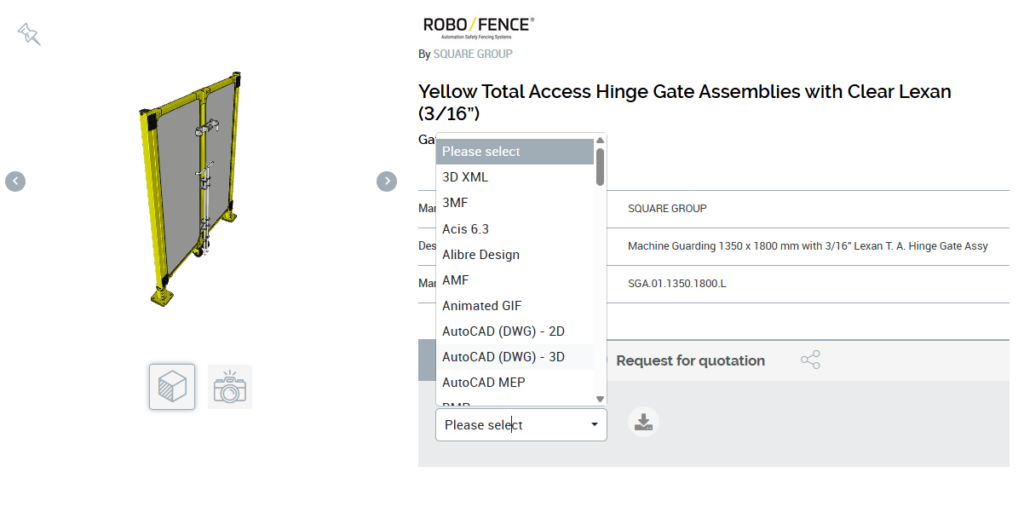
As a leader in custom robotic guarding systems, ROBO FENCE® helps manufacturers maintain worker safety and simplify the design process. We offer a convenient layout generator for planning, along with detailed 3D CAD models of our posts, panels, gates, and brackets.
Visit our website to explore our models, or contact us today with any questions or for design assistance.
Contact one of our experts to get started on your next machine guarding project. Until then, browse our complete catalog to see our offerings.
Square Group LLC
Proud Manufacturers and Suppliers of ROBO FENCE®