Cable Management Safety: Importance of Proper Support Brackets
Cable tray support brackets are often overlooked in robotic cell design, even though they impact uptime. Get selection tips, professional insight, and more.
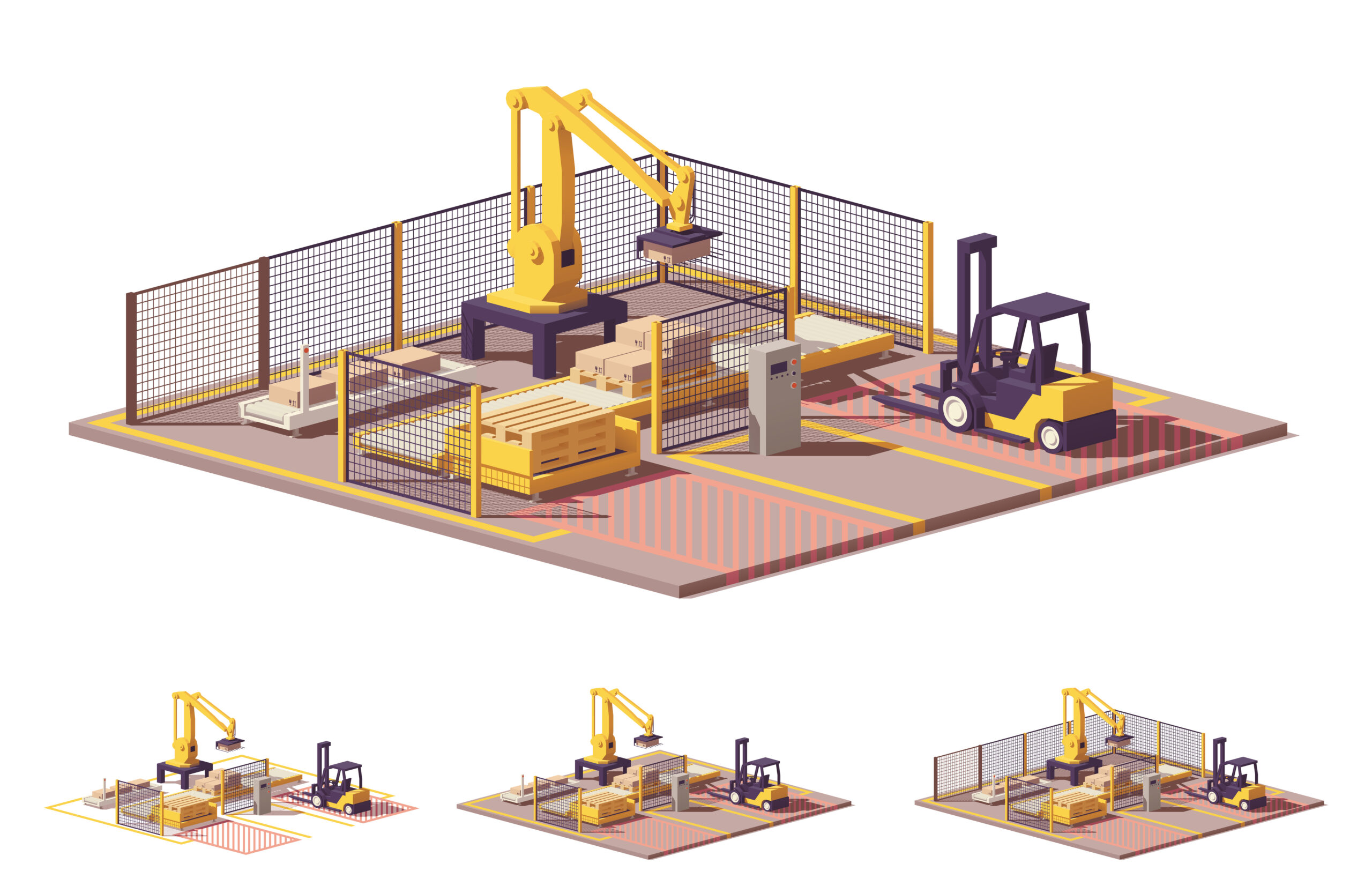
Robots move quickly, creating a risk of hitting anyone nearby, a product coming loose from the robot’s gripper, or the gripper detaching from the arm. To prevent accidents around automated equipment, the usual practice is to keep workers away from hazardous areas, which is usually accomplished with fencing. However, there may be certain processes requiring frequent access to the equipment, or where fencing reduces visibility in ways that cause problems. In these situations, other technologies, such as safety mats, may be helpful.
Before we discuss the differences between mats and fencing, we want to emphasize the importance of performing risk assessments because this is going to be the only way you’ll know whether each option is enough to address the risks unique to your workplace.
Ideally, a risk assessment is performed during an automation project’s design phase, but it should be repeated after implementation and commissioning, and whenever any aspect of the facility layout or workflow changes.
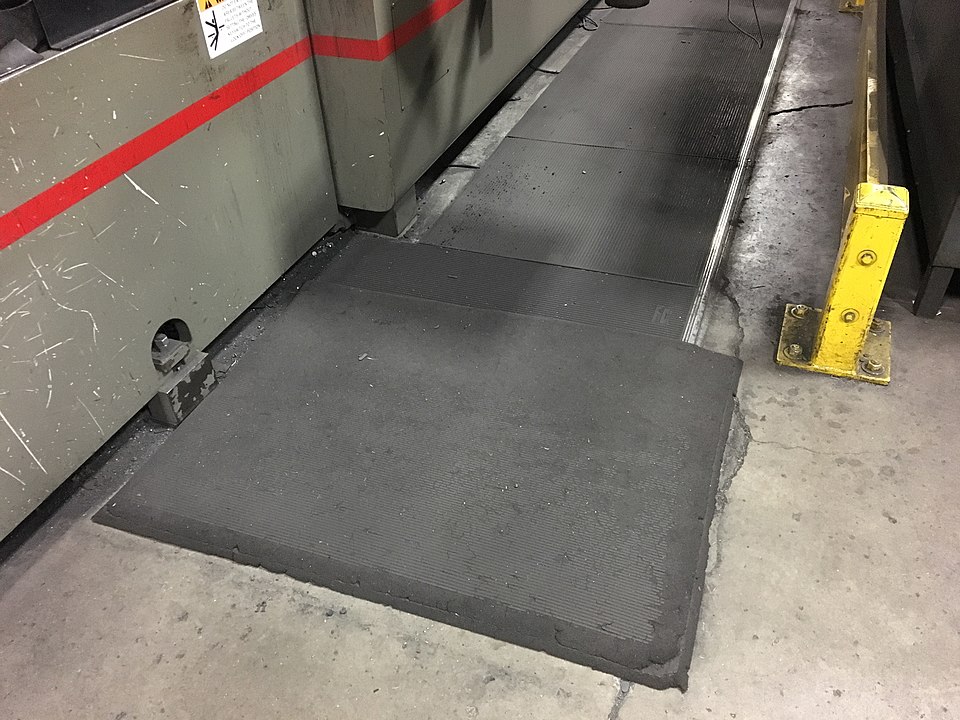
A safety mat is a large pressure switch that’s placed on the floor. It’s typically made from a rugged elastomeric material and features integrated metal plates.
When a load is placed on the mat, the plates come together, completing an electric circuit that sends a signal to a safety controller. From here, if a load is detected on the mat, the controller stops cell movement.
Safety mats, which should comply with the ISO 13856 standard, are designed to operate at pressures over 45 pounds. A key consideration when placing safety mats around automation is distance. They must be far enough away from the hazard that motion stops before someone could cross that mat and put themselves in danger.
It’s also important that no gaps are left around the equipment where someone could cut through.
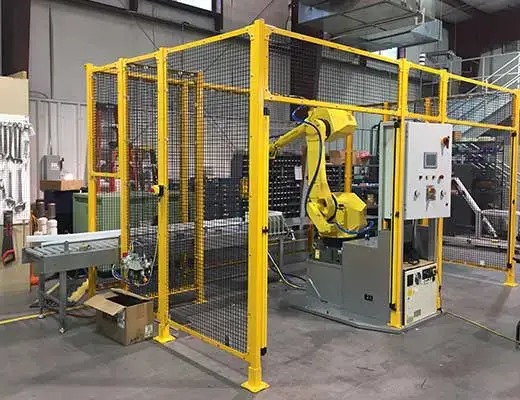
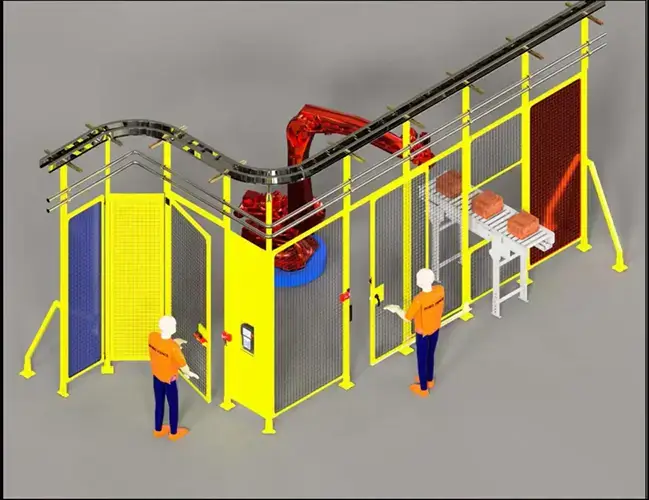
Safety fencing is constructed with vertical panels (made from a variety of materials), secured to floor-mounted vertical posts, and placed around the automation equipment or robot cell with hinged or sliding gates. These gates use interlock switches that connect to the automation or safety controller, killing motion when they are opened.
Most safety fencing panels are mesh within a solid outer frame. The size of the mesh determines the largest object that can pass through and establishes the distance required from the moving equipment. Fencing is also colored a highly visible yellow, although other options are possible.
If machinery or industrial robots release dust, liquids, or other debris, mesh panels can be replaced with transparent or solid panels.
ROBO FENCE® supplies rugged, OSHA-compliant safety fencing for robotic cells, manufactured by our partner, Square Group. Our specialists can help you identify the best safety solution for your facility based on your risk assessment and provide design consultations as needed.
Visit our website to learn more about our capabilities, or contact us today to speak with a specialist.
Contact one of our experts to get started on your next machine guarding project. Until then, browse our complete catalog to see our offerings.

Square Group LLC
Proud Manufacturers and Suppliers of ROBO FENCE®